
Leave Your Message
Engineered for rapid mobilization, extreme weather survivability, and versatile operational reconfiguration across worldwide forward operational posts.
In contemporary multi-domain military operations, tactical expeditionary readiness hinges on the capability to rapidly establish, sustain, and relocate operational infrastructure under unpredictable environmental and adversarial conditions. Traditional brick-and-mortar structures or heavy prefabricated containerized units suffer from significant logistical handicaps: high transportation tonnage, long setup timelines, labor-intensive assembly, and static vulnerability. The advent of modern Tensile Roof Structure Design for Military Temporary Operational Shelters represents a transformative paradigm shift in defense expeditionary architecture.
By leveraging computational form-finding, high-tenacity architectural membranes (such as PVDF-coated polyester fabrics, PTFE fiberglass, and fluoropolymer composites), and pneumatic or lightweight structural framing, military engineers can deploy expansive, column-free protective enclosures within hours. These structures serve diverse operational envelopes—ranging from Forward Operating Base (FOB) Tactical Operations Centers (TOC) and Combat Aviation Maintenance Shelters to climate-controlled expeditionary medical treatment facilities and secure munitions warehouses.
Pre-engineered modular components and pneumatic air-beam or tensioned-cable systems reduce installation duration by up to 80% compared to conventional rigid steel shelters.
Advanced aerodynamic curvature and non-linear stress distribution withstand hurricane-force winds up to 150 km/h, heavy snow loads exceeding 1.5 kN/m², and extreme UV radiation.
Low-thermal-emissivity linings, anti-glare outer barriers, and radar-absorbent coatings mitigate infrared signatures and enhance electronic warfare concealment.
Designing tensile roof structures for expeditionary defense infrastructure demands rigorous non-linear finite element analysis (FEA). Unlike conventional rigid buildings governed by compressive and bending stresses, tensile membrane systems resist external environmental loads purely through in-plane tensile pre-stressing and double-curved anticlastic geometry (hyperbolic paraboloids, conoids, and saddle shapes) or synclastic pneumatic stabilization.
Form-finding algorithms compute the equilibrium shape where surface stresses are uniformly distributed under initial prestress. When subject to dynamic environmental actions such as wind uplift, turbulence, or asymmetrical snow accumulation, the curved tensile membrane redistributes forces along primary catenary and radial cable paths down to anchoring footings. This eliminates localized stress concentrations, preventing tearing and cataclysmic structural failures.
Military operational shelters utilize multi-layered composite membranes engineered for harsh battleground climates:
The operational agility of modular tensile roof shelters makes them indispensable across the entire spectrum of military expeditionary missions, disaster relief operations, and peacekeeping logistics:
Continuous command-and-control capabilities require airtight, climate-stabilized enclosures shielded from electromagnetic interference (EMI/EMP), external dust, sandstorms, and thermal detection.
Clear-span designs ranging from 15 to 60+ meters accommodate fixed-wing aircraft, attack helicopters, and unmanned aerial vehicles (UAVs) without interior support column interference.
Anti-microbial, sealed air-supported or tensioned frame shelters equipped with positive-pressure HEPA filtration systems provide sterile surgical and triage environments in contagion or combat zones.
High-clearance tensile structures safeguard heavy armored assets, precision ammunition, and supply chains against rain, direct solar radiation, and humidity degradation.
| Engineering Parameter | Air-Supported Tactical Dome | Air-Rib Inflatable Hangar | Steel-Tension Hybrid Shelter |
|---|---|---|---|
| Deployment Speed | 24 – 48 Hours | 4 – 8 Hours | 3 – 5 Days |
| Clear Span Capability | Up to 120+ meters | Up to 45 meters | Up to 80 meters |
| Wind Resistance Rating | 140 – 160 km/h (Beaufort 12+) | 120 – 140 km/h | 150 – 180 km/h |
| Snow Load Capacity | 1.0 – 1.8 kN/m² | 0.6 – 1.2 kN/m² | 1.5 – 2.5 kN/m² |
| Thermal Insulation (U-Value) | 1.2 – 1.8 W/m²·K (Dual Layer) | 1.5 – 2.0 W/m²·K | 0.9 – 1.4 W/m²·K (Insulated) |
| Blackout & IR Camouflage | 99.9% Light Blockout / Low-E | Integrated Camo Skin | Multi-layer Tactical Shell |
| Transport Logistics Volume | Extremely Compact (Palette Fold) | High-Mobility Containerized | Standard Flat-Rack Containers |
As defense forces pivot toward distributed maritime operations and agile combat employment (ACE) doctrines, military engineering procurement is increasingly embracing technological advancements in membrane materials and intelligent monitoring systems:
1. Integrated Flexible Photovoltaics (BIPV): Modern tensile shelter roofs are being fitted with lightweight, shatterproof thin-film solar laminates. These harvest renewable power in off-grid field locations, significantly reducing reliance on vulnerable diesel fuel supply convoys.
2. Structural Health Monitoring (SHM) via IoT: Embedded fiber-optic sensors and wireless tension monitors continuously assess membrane stress, air-pressure stabilization, and snow accumulation in real time, alerting command teams to maintenance thresholds before structural risks arise.
3. Autonomous Robotic Fabrication and Packaging: High-frequency automated robotic welding and computer numerical control (CNC) plotters ensure military shelters achieve microscopic weld integrity, leak-proof airtightness, and ultra-compact packing ratios tailored for rapid air-drop or tactical ground transport.
Yifan Air Dome is a high-tech enterprise dedicated to innovative, eco-friendly air-supported membrane structures and integrated air dome building solutions. As a leading integrated service provider in the application of membrane structure technology across China, we cover the full industrial chain of R&D, design, manufacturing, installation and full-cycle operation and maintenance, delivering high-efficiency, energy-saving and low-carbon sustainable building space solutions for global clients.
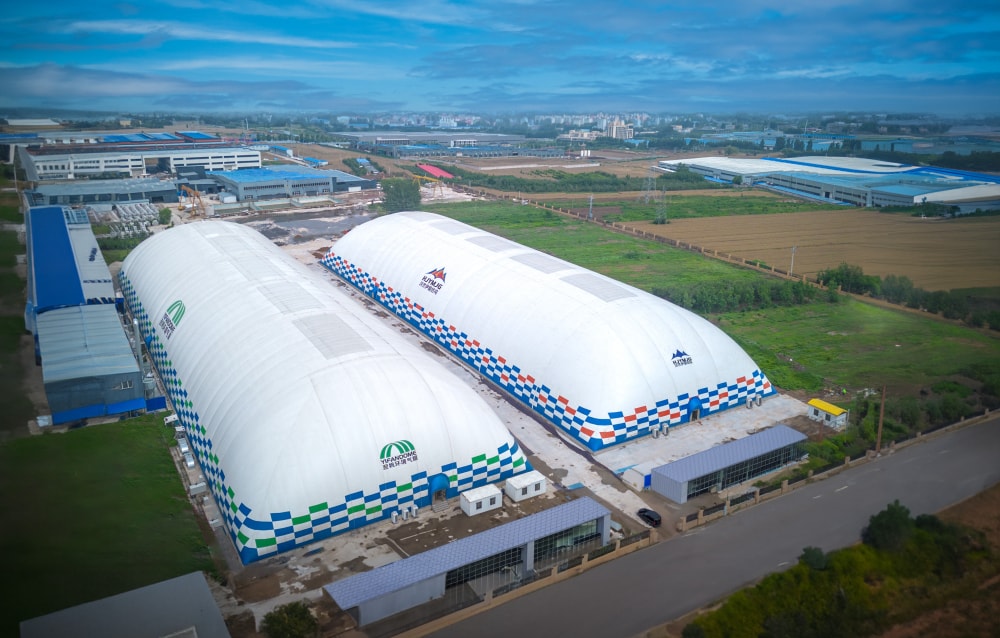
With years of deep cultivation in the air dome and membrane structure industry, we adhere to the development philosophy of green low-carbon, technological innovation and quality priority, and strictly comply with industrial construction and production standards. Supported by standardized production techniques and abundant experience in large-scale project implementation, we professionally customize various air domes, including sports stadiums, industrial warehouses, environmental enclosures, cultural tourism venues and exhibition membrane buildings, which are widely applied in sports fitness, industrial storage, environmental dust prevention, cultural tourism scenic spots and public supporting facilities.
From raw material testing to automated CNC cutting and high-frequency welding, our state-of-the-art facility delivers battle-proven tensile structural engineering.
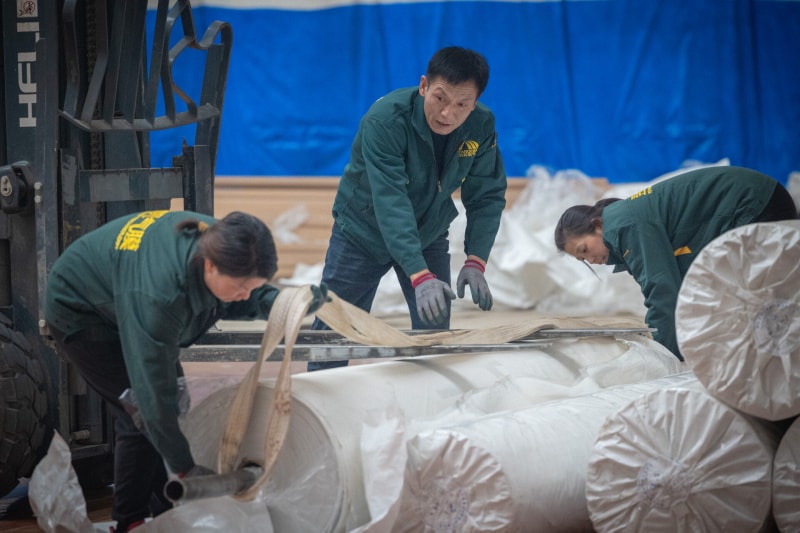
1. Select the customized membrane material
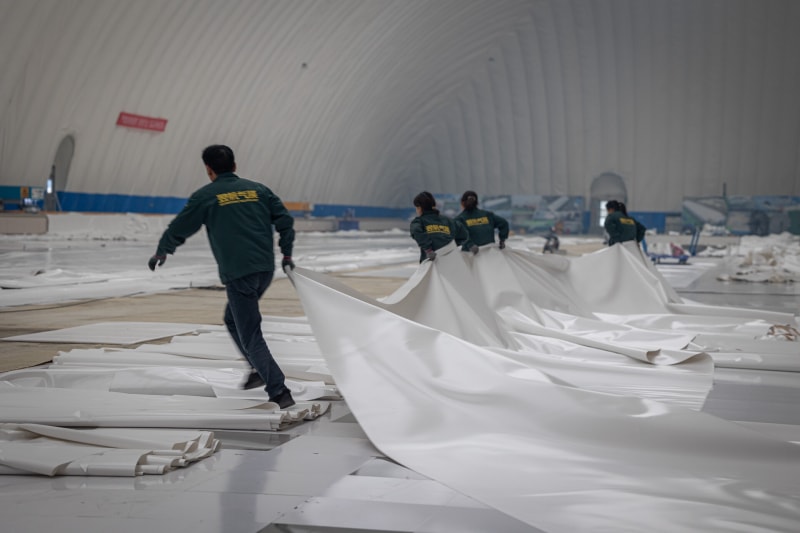
2. Deploy the membrane material
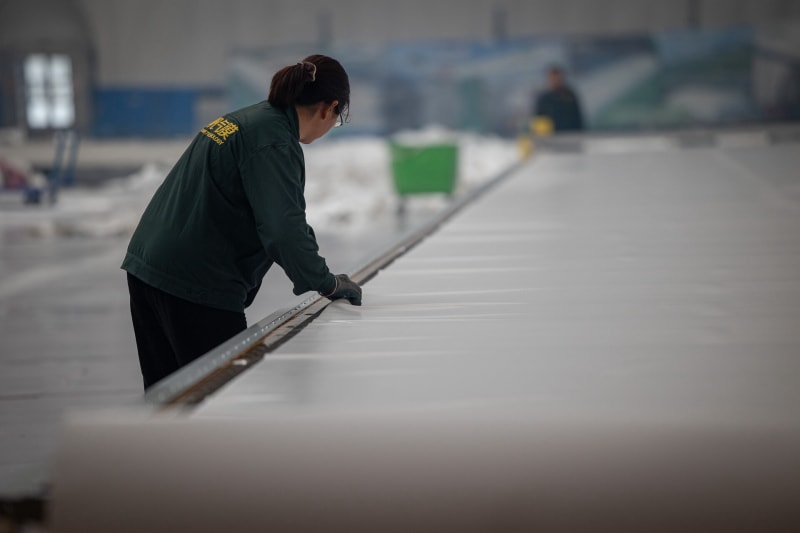
3. Lay the membrane material on the automated cutting machine and import flat design drawings
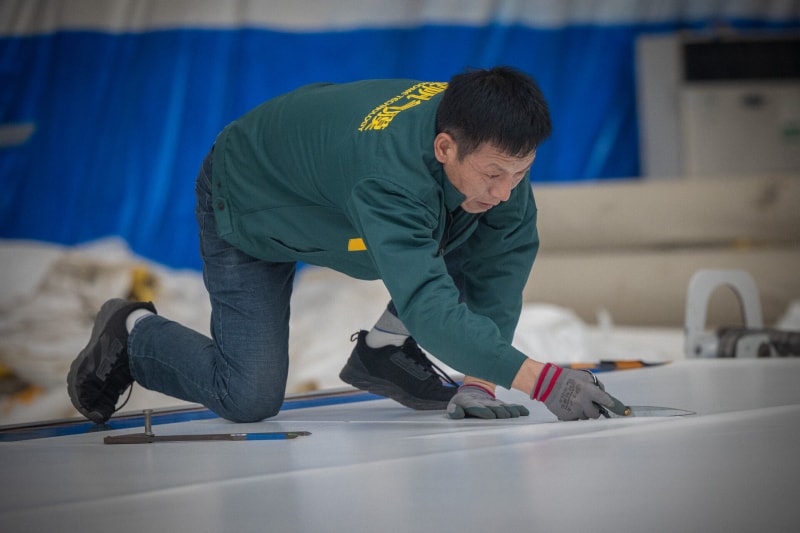
4. Manually trim the edges of the membrane material to ensure a secure weld
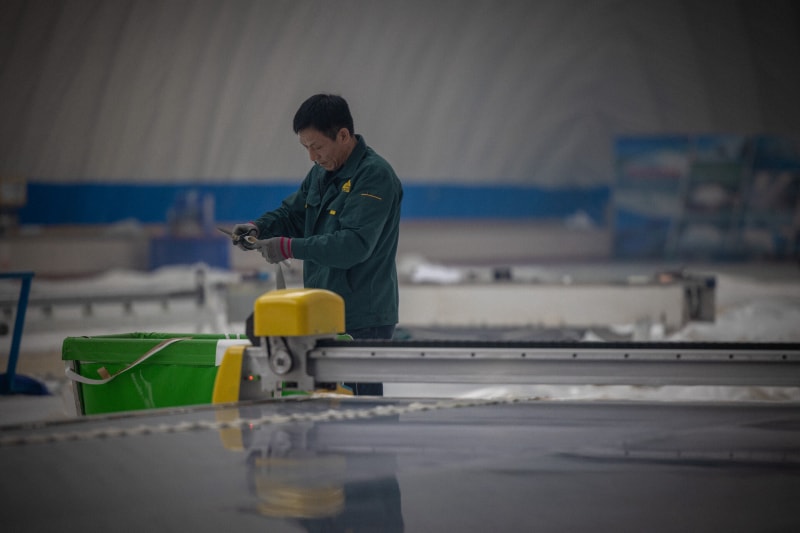
5. Cutting, Splicing, and Reinforcement Strips
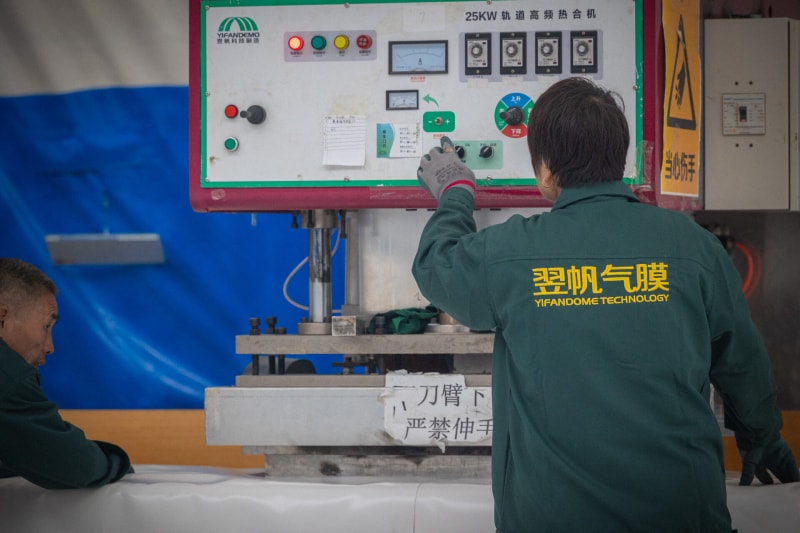
6. Arrange membrane materials and weld via track-type high-frequency heat-sealing
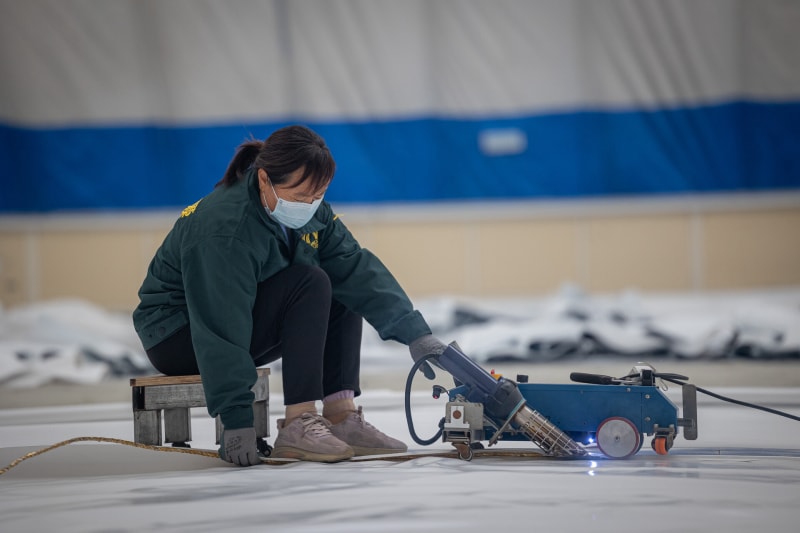
7. Small Hot Sealer Welding Rope Channel
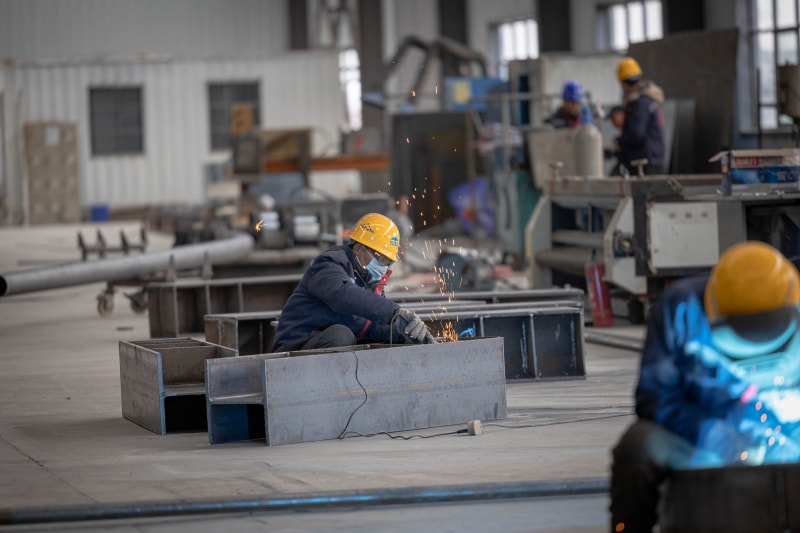
8. Manufacturing aluminum alloy clamps, door/window fittings, and inflatable pipes
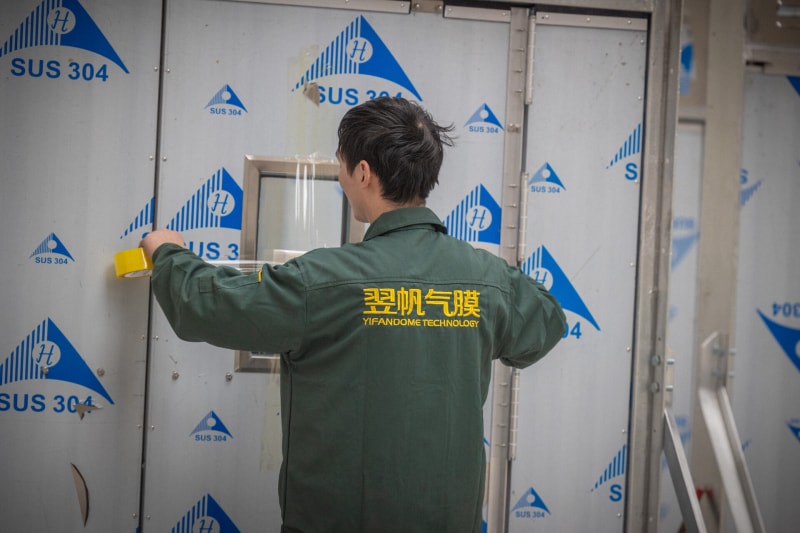
9. Check the product, pack it, and prepare for rapid global transportation
Explore our full line of temporary and semi-permanent tensile roof structures adapted for extreme tactical operational scenarios.
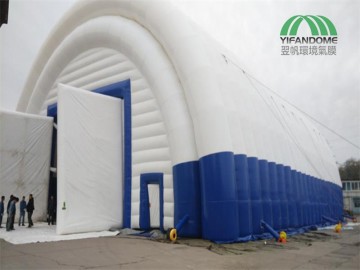
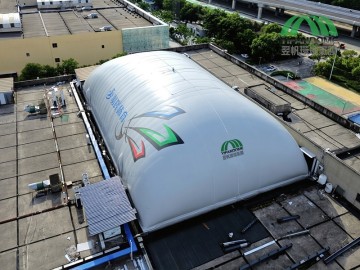
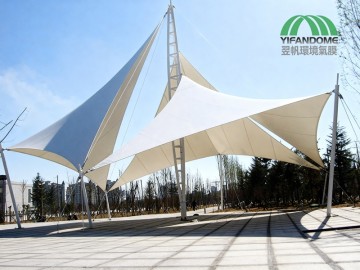
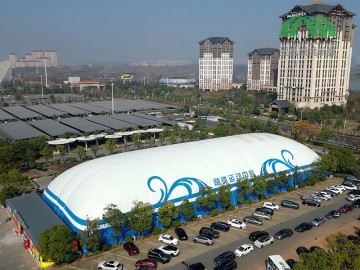
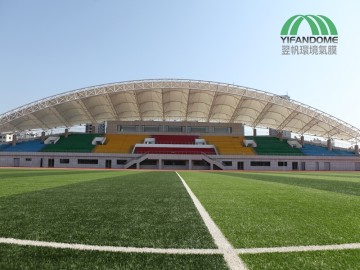
Collaborate with our structural engineering team to design, manufacture, and deploy custom military operational shelters tailored to your specific wind load, thermal envelope, ballistic mitigation, and footprint requirements.